
Quality of Experience
Definition: Quality of Experience measures the different key metrics to come up with the overall performance of video from the user's point of view.
What is the Quality of Experience?
You post a video and gain engagement and now: How do you measure or understand what hundreds of your viewers experience while watching your content? The good, the bad, and the ugly. Good, so you can continue. Bad and ugly so you can quickly iterate and improve.
For instance, to know your viewer experiences, you create a rating template, and the viewer puts a rating of 3 out of 5; it prompts the question: Why 3? What aspects influenced this rating? The rating can give you an idea of what the experience is for the users, but it can’t show where the problem lies.
This is where metrics like Quality of Experience(QoE) come into play, offering insights into user perspectives to pinpoint potential issues.
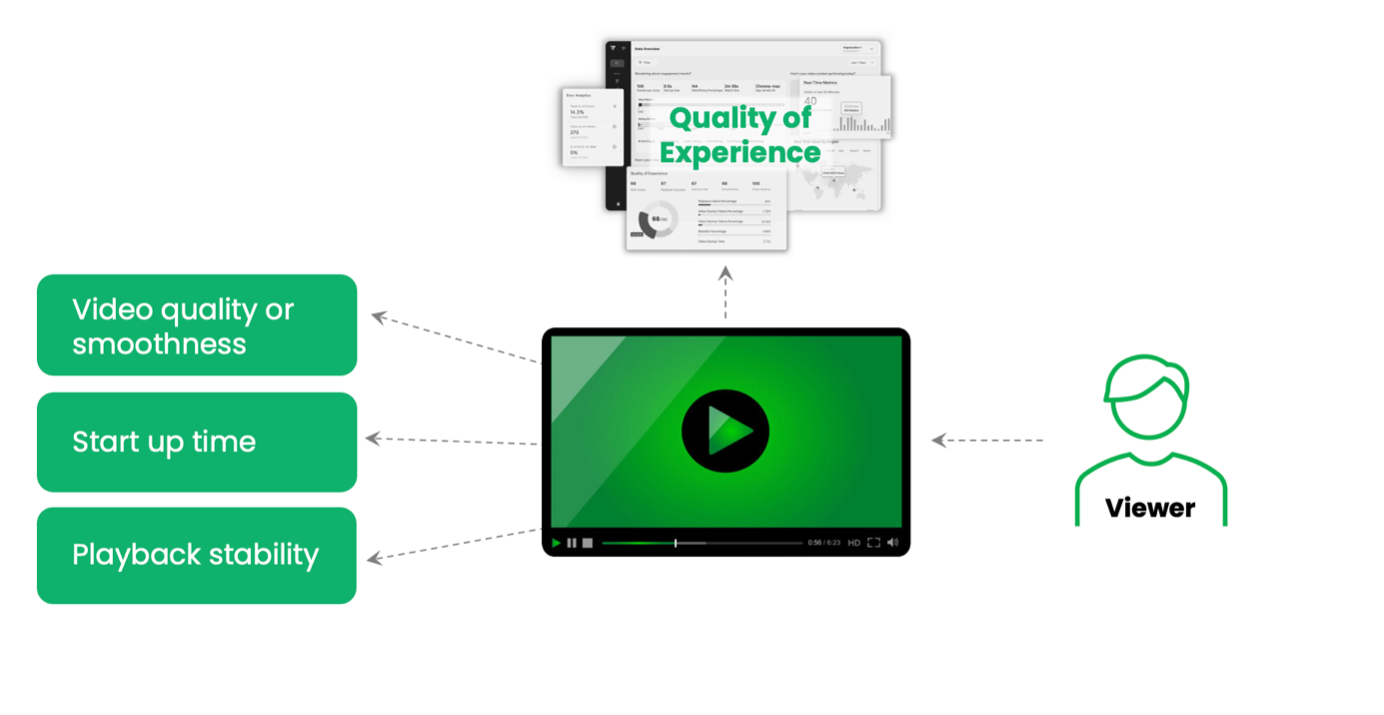
Video's Quality of Experience (QoE) involves the evaluation of key metrics such as video quality, start-up time, playback stability, and playback success performance. By carefully analysing each of these parameters, we can determine the video's overall performance.
Why is the quality of experience important?
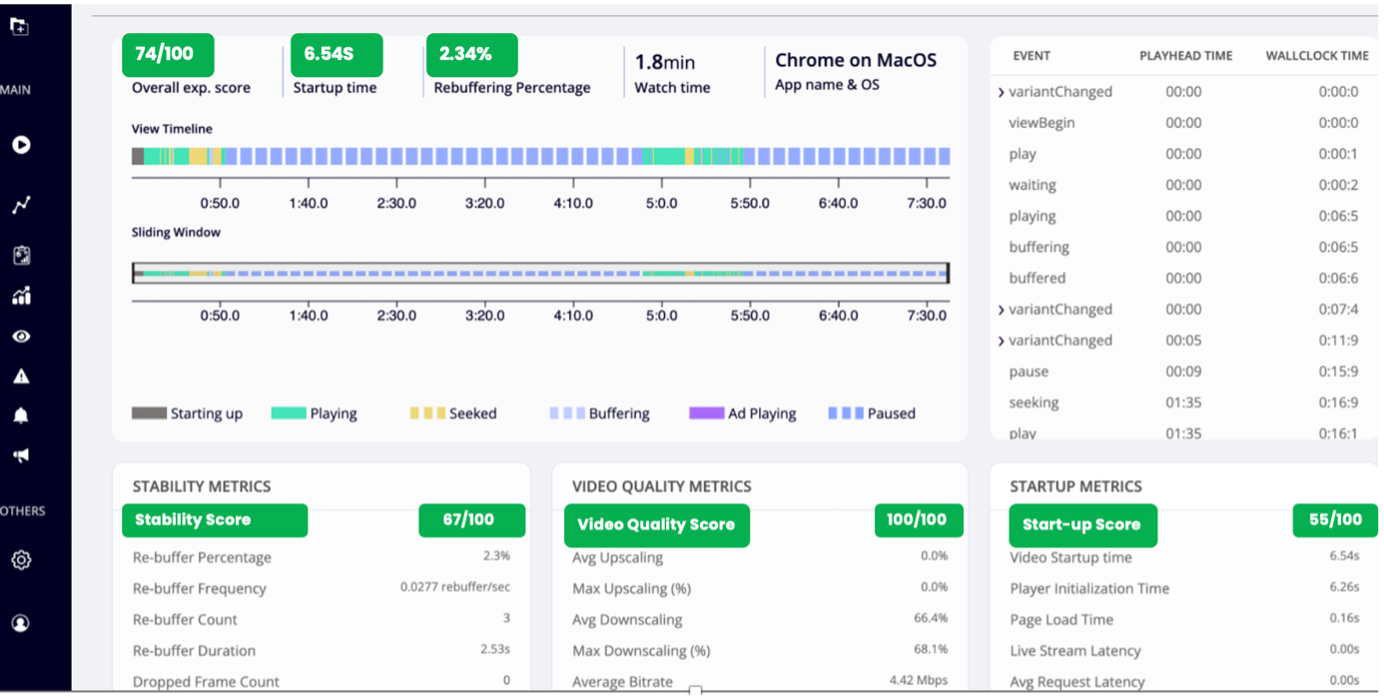
When you refer to the QoE above, look at how each metric is considered while coming up with the overall score. Suppose we take this diagram as an example. The quality of the video is 100, with a buffer percentage of 2.34%, which is acceptable, but the start-up time was a bit longer at 6.54s, because of which the overall score dropped to 74%. The reason why QoE is important is that even a second delay in video loading can reduce the overall score.
QoE helps to understand where exactly the problem lies or where it needs improvement. For instance, in the diagram above, the overall score is 74%, which is decent, but it needs improvement with the start-up time.
Key metrics of quality of experience?
QoE measures the overall satisfaction and perception of the users; unlike other metrics that focus on only technical performances, QoE also focuses on how the user interacts with the content. There are different metrics to measure QoE depending on the needs.
Here, are the common metrics of QoE with videos:
Video buffering: The audience doesn’t tolerate buffering anymore, so if your video buffers for too long, it could affect the QoE.
Video quality: The quality of a video depends on the bitrate, resolution, and frame rate; messing with either of them can lead to blurry, take a long time to load, and pixelated video that the audience will skip in a heartbeat.
Video start-up time: The time it takes for a video to start can impact viewers' experiences. Lengthy start-up delays may lead to frustration, leading people to stop engaging with the content.
Playback failures: When videos don't play smoothly and encounter issues like freezing, it can make the viewer experience frustrating.
What are the factors that affect the Quality of Experience?
QoE's most common factors are:
Network condition: A slow internet connection can cause buffering and glitches; video lag and slow page loading affect the experience of the video; whereas a high-speed network could seamlessly play any content. According to a study, most viewers blame the network connection for their video buffers and not the streaming platforms.
Device performance: The Quality of Experience can be influenced by the capabilities of the device you're using, such as a smartphone or tablet. Older or less powerful devices might encounter challenges when handling high-quality video content. For example, a client may express dissatisfaction, stating that their phone, running on Android 7, is unable to process the content. Sometimes, there's not much you can do to fix these issues, and it can impact the overall experience.
Player: While streaming a video, players play an important role in QoE. Some things to consider are whether the player supports different video formats and if it can adjust the quality based on your internet speed. A player with easy-to-use controls and subtitles is also important.
Geographic location:The physical location can influence the availability of content and the speed of content delivery. Content delivery networks (CDNs) may vary in efficiency depending on your geographical location.
Poor coding: If the code behind an application or website is poorly done, it can cause a lot of problems for users. It might be slow, crash often, or have trouble working on different devices. This not only frustrates users but also makes them doubt the reliability of the service.
FAQs
Differences between QoE and QoS
Quality of Service (QoS) and Quality of Experience (QoE) are two important aspects when it comes to evaluating and enhancing performance. QoS acts like a traffic controller for the network, ensuring that different types of data get the right priority and smooth passage through the internet highways. It focuses on technical details like how fast data travels and how reliably it reaches its destination. On the other hand, QoE is all about the viewer's satisfaction. It measures factors like video and audio quality, responsiveness, and overall performance.
Is QoE important just for video technology?
NO! QoE is used across all industries and fields to get insight into their customer's satisfaction and what areas need improvement.
For instance, a founder or a marketing person may be concerned with the quality of the viewing experience. This is not about video technology, but about what technology, content and UX together achieve when a customer watches your content. QoE allows different stakeholders to get the right data, analytics and tools that help achieve their specific objectives.
What is the video stability metric in QoE?
Video stability metrics assess the stability of a video by considering various factors such as buffering percentage, frequency of buffering, frame count, and more. The result is a score on a scale of 0 to 100, indicating the overall stability of the video playback.
Related terms
Making video dead easy for developers
We've put together valuable insights in the form of blogs and guides. Check'em out
Microlearning vs e-learning: 6 differences that change how you build
Microlearning is not just shorter e-learning. Six architectural differences that change how you build, plus a drop-in path for existing e-learning platforms.

What is Video Streaming? Is it Really Hard to Stream Videos Online?
Video streaming explained: how it works, the past-present-future arc, why it's hard to build, and how modern APIs like FastPix abstract the complexity.
How to publish a pre-recorded video as a live stream
Stream pre-recorded videos as live in 2026. Compare OBS + FastPix, Cloud Playout, and API workflows. Setup steps, pros and cons, and when each one fits.

Impact of churn on OTT Platforms: Insights and solutions
Understanding churn's impact on OTT platforms is essential for developing effective strategies to boost retention and improve user satisfaction.
How to create an iOS Streaming app: Step-by-step guide
Build an iOS live streaming app in 2026. Step-by-step Swift tutorial with HLS playback, RTMP ingest, app store submission, and FastPix backend. No infra needed.
How to create a streaming channel with live and scheduled content
Build a 24/7 streaming channel that mixes live and scheduled VOD content with FastPix Cloud Playout. Setup, scheduling, switching, and distribution steps.

How much does it cost to build a microlearning app in 2026?
Line-by-line cost breakdown for building a microlearning app in 2026, the hidden charges that wreck budgets, and how to cut 40-60% without losing features.

5 best Cloudflare Stream alternatives in 2026
Cloudflare Stream wins on cost. Compare 5 honest alternatives that ship deeper analytics, native AI, and broader SDK coverage for video-first products.

Best video streaming analytics tools for developer teams in 2026
Streaming analytics tracks QoE, not surveillance. Compare FastPix Video Data, Mux Data, and Bitmovin Analytics on metrics, SDK breadth, and pricing tiers.

How to build a TikTok-style microlearning app
This article is a step-by-step build guide for engineering teams shipping a TikTok-style microlearning app. It covers what microlearning apps are, the two main types, the features that decide whether the app survives, the mistakes that quietly kill launches, and an action-driven sequence of steps to ship one. The video infrastructure section doubles as a mini-tutorial using the FastPix API. Aimed at developers, product managers, and founders building swipe-to-learn experiences in 2026.